

That question comes up before the technician’s van even leaves the driveway, and the honest answer sits somewhere between 30 minutes and 24 hours. Face fibres often feel dry to the touch within 30 to 60 minutes, yet the backing and the cushion underneath can stay damp for 6 to 12 hours or longer under ordinary indoor conditions. That gap between what your foot feels and what the carpet actually holds explains most of the confusion around timing, and getting it wrong risks flattened pile, fresh staining, or a musty smell that lingers for weeks.
How Long Does Carpet Cleaning Take to Dry

Carpet cleaning drying time is rarely a fixed number, since it depends on the method used, the water volume applied, and the humidity sitting in your home that day. Steam cleaning, the common name for hot water extraction, pushes heated solution deep into the fibres, and the carpet typically needs 6 to 12 hours before it handles normal traffic, sometimes stretching past 20 hours when a room stays humid. Rooms treated with encapsulation or another low-moisture system get wet only at the top of the pile, so light footsteps are often fine within 30 minutes to 2 hours. Almost no liquid goes into a carpet during dry compound cleaning, a reason many commercial spaces pick it when a room needs to reopen the same day. Guidelines published by the IICRC classify a carpet as fully dry only once the cushion beneath matches the humidity of the room, typically 12 to 24 hours after hot water extraction on thicker piles.1
Carpet Cleaning Drying Time by Method

The method chosen during your appointment shapes almost everything about the wait that follows, so a side-by-side comparison helps.
| Cleaning Method | Typical Drying Time | When Light Traffic Is Safe |
| Hot Water Extraction | 6 to 12 hours, up to 24 in humid rooms | 2 to 6 hours, socks only |
| Encapsulation | 30 minutes to 2 hours | Once the surface feels dry |
| Dry Compound Cleaning | Minimal, ready after vacuuming | Right after the service |
| Bonnet Cleaning | 1 to 3 hours | Once the pile feels dry throughout |
| DIY Rental Shampooing | 24 to 48 hours | Wait for full confirmation first |
Factors Affecting Carpet Drying Time

A handful of variables work together here, and none of them act alone.
- Room humidity above 60% narrows the gap between carpet moisture and air moisture, stretching a 6-hour dry into 18 hours or more.
- Fibre type changes everything. Wool holds close to 30% of its dry weight in moisture, so wool rug cleaning jobs generally call for extra patience compared with nylon or polyester blends.
- Air movement plays its own part. A closed room with no fan running traps humid air above the carpet and slows evaporation to a crawl.
- Dense plush and looped berber constructions trap water inside their own loops, which pushes the wait well past a flat weave.
- Equipment quality separates a quick dry from a slow one. Truck-mounted extraction units pull out 85 to 95% of the water they apply, while smaller rental machines often leave much more behind in the padding.
How Long After Carpet Cleaning to Put Furniture Back
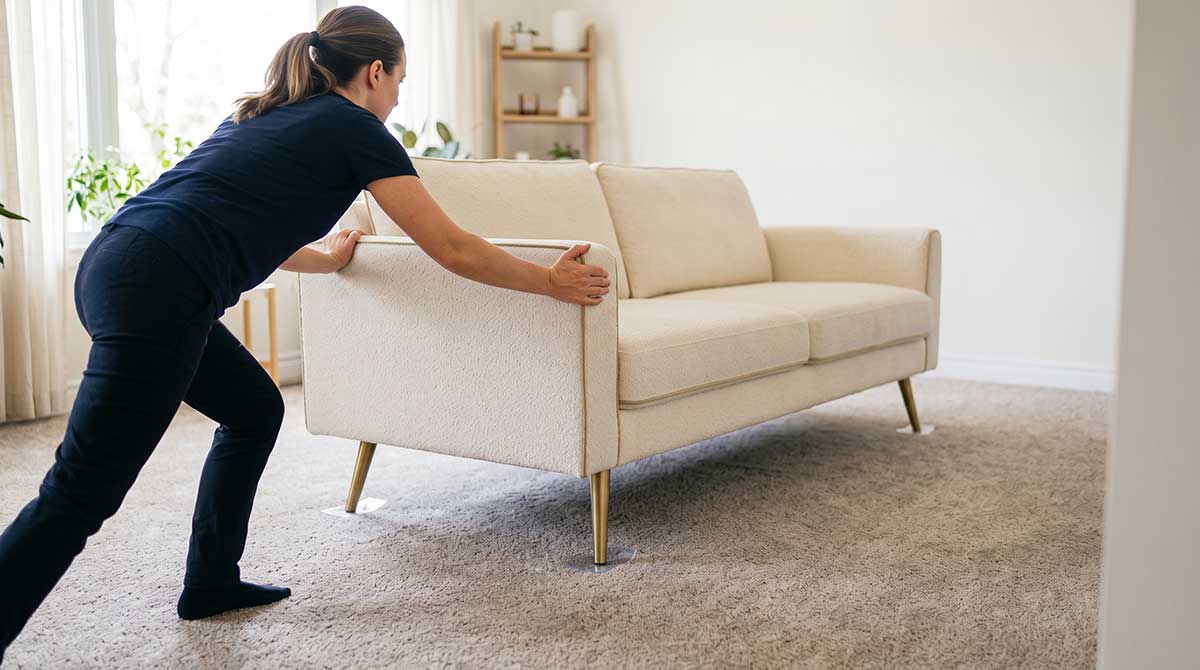
Furniture placement causes more avoidable damage than foot traffic ever does. Wooden legs resting on damp fibres can leach dye or varnish straight into the pile, and metal glides left on damp fibres tend to rust and stain the surface, a rug repair headache that keeps specialists busy every spring. Waiting for full dryness, generally 12 to 24 hours, gives furniture a safe path back to its original spot.
A few habits reduce the risk when a full wait isn’t realistic.
- Slide protective aluminum foil squares or rigid plastic tabs under every leg if furniture must return early.
- Check corners and low clearance areas first, since airflow drops near walls and beneath furniture, leaving those spots damp after the open floor feels fine.
- Keep area rugs off a carpet that hasn’t finished drying, because trapped moisture underneath encourages mould.
- Hold off on repositioning heavy pieces until the pad beneath the main carpet has caught up, not just the visible surface.
How Long Does Professional Carpet Cleaning Take

A typical hot water extraction appointment for a few rooms runs between 45 minutes and 2 hours, depending on soil load and square footage, and the drying period afterward can run 6 to 24 hours. Technicians using truck-mounted equipment and strong vacuum lift finish the extraction quickly, and that suction is part of why professional jobs often dry faster than a rented machine covering the same square footage.
Confirming Your Carpet Is Actually Dry
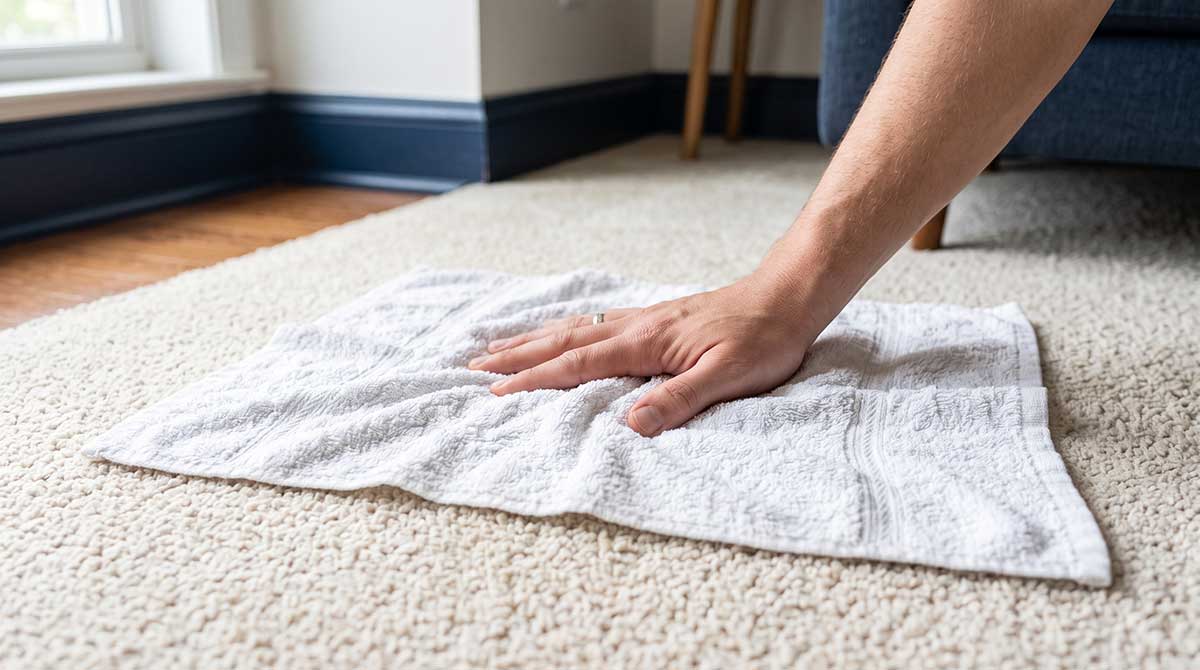
Surface feel alone misleads plenty of people, since face fibres dry long before the backing does. Press a clean white towel firmly against a high-traffic path or a room corner for about 10 seconds, then check the cloth for dampness. A dry towel across several spots means the pile and backing have reached functional dryness, while any moisture on the cloth means that room still needs restricted access and dry socks only. Extended dampness carries its own risk beyond inconvenience. Guidance on moisture control in buildings from the EPA notes that materials staying damp beyond 1 or 2 days raise the odds of mould colonization.2 Rooms rarely finish drying at the same rate, so test a few different spots rather than trusting a single check near the doorway.
Weather, room size, and the cleaning method chosen will always change the exact number of hours, but patience paired with a simple towel test beats rushing furniture and foot traffic back in.
If timing still feels uncertain, get a quote from us and let a trained crew manage the whole process for you.
References
- International Cleaning and Restoration Association. IICRC Consumer Floor and Furnishings Care Information. IICRC, n.d.
- “A Brief Guide to Mold, Moisture and Your Home | US EPA.” US EPA, 18 Feb. 2026, www.epa.gov/mold/brief-guide-mold-moisture-and-your-home.